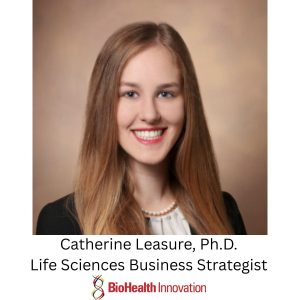
 By Catherine Leasure, Ph.D., BHI Life Sciences Business Strategist – If you’ve written a grant recently, you’ve probably wondered whether AI could make the process easier. Maybe you’ve already tried it. The honest answer is that AI can help, but how much depends entirely on what you bring to it. When you know what you’re doing, it gets you to a solid draft faster. However, without a strong grasp of the process behind it, it can produce polished-sounding text that misses the mark in ways that aren’t always obvious until a reviewer or experienced grant writer points them out.
Where AI Earns Its Keep
The tasks where AI performs best are the ones that are time-consuming but relatively mechanical. Generating a document outline that accounts for both grant requirements and your specific project content is a good example. What might take an hour of cross-referencing a funding opportunity announcement can be done in minutes with the right prompt. From there, AI can help turn that outline into a working first draft and translate dense technical language into plain descriptions for non-specialist reviewers, which is particularly useful when generating ancillary documents like abstracts or project summaries that need to be accessible to a broad audience.
AI also shines in the later stages of drafting. Grant applications are long documents, and inconsistencies are easy to overlook when you’ve been working on the proposal for weeks or months. Terminology that shifts between sections that were written by different people, early claims that aren’t fully supported later in the document, and overly wordy sentences are all the kinds of issues that AI excels at catching and fixing. It can also serve as a compliance checker, making sure required sections are present and that the structure of your application matches what the solicitation requires.
None of this replaces the thinking that goes into a competitive application. But it does free up time and mental energy for the parts that require it.
Where AI Falls Short
The same confidence that makes AI useful in the drafting process can work against you when the content and strategy require nuance. AI can misrepresent novel technologies, fabricate citations, or produce technically plausible descriptions that are subtly wrong (this is called hallucinating). For early-stage companies with innovative science, this is a real risk. AI can only work with what you give it. If you’re not providing detailed, accurate information about your technology and approach, it will fill in the gaps on its own, and not always correctly. You need someone who actually understands the technology both guiding the prompts and reviewing anything AI generates before it goes into your final draft.
Beyond accuracy, there’s a layer of strategic knowledge that AI doesn’t have access to. It can’t tell you how a program officer has been framing their priorities in recent conversations, what a review panel tends to weigh most heavily, or whether your project is actually a good fit for a particular solicitation before you invest time writing your proposal. That kind of information comes from reaching out to and meeting with program officers before you submit. These conversations can reshape an application in ways that no AI tool can replicate.
Then there’s the writing itself. Even the best prompts can produce text that experienced reviewers recognize immediately: sentence structures like “it’s not X, it’s Y,” excessive adjectives, and the overuse of certain punctuation are all patterns that show up repeatedly in AI-generated text. Beyond the stylistic tells, AI tends toward a kind of confident vagueness that sounds thorough but doesn’t actually say much. In competitive grant programs, that kind of generic writing loses. If AI contributes to any part of your draft, it’s the grant writer’s job to make sure the final product sounds like it was written by a real person. Reviewers who are engaged with your writing are more likely to be engaged with your science.
Finally, using AI to write your grant poses a potential confidentiality risk that often goes overlooked. When you paste proprietary information about your technology into a public AI tool, that content may be used to train the model, and there is no guarantee it will stay private. Details about your innovation could potentially surface in someone else’s results! Treat any public AI tool the way you would any other unsecured channel: don’t put anything in that you wouldn’t be comfortable sharing publicly.
Agency Guidance on AI Use
Some funding agencies have begun addressing AI use in applications directly. NIH, for example, recently issued guidance stating that applications that are substantially developed by AI will not be considered original ideas of the applicant, and that the NIH employs AI detection tools to identify AI-generated content (NOT-OD-25-132). Applications found to be in violation post-award can face serious consequences, including cost disallowance, grant suspension, or termination. The NSF has taken a slightly more lenient approach, requesting that proposers disclose whether AI tools were used when preparing an application. The NIH and the NSF are not alone in scrutinizing AI use, and it is reasonable to expect other agencies to follow suit as AI use becomes more widespread.
The Bottom Line
AI is a useful tool in the grant writing process, but it works best as a starting point, not a final product. The applications that score well aren’t necessarily the ones with the smoothest prose, they’re the ones that demonstrate a clear understanding of the funding landscape, make a compelling scientific case, and show reviewers that the team behind the project knows what they’re doing. That requires expertise that no prompt can substitute for.
Used effectively, AI can get you to a better draft faster. But knowing how to use it thoughtfully, and knowing when not to rely on it, is itself a skill.
Work with Us
At BHI, we work with clients from the earliest stages of identifying the right funding opportunity through grant submission, including helping determine where AI can speed up the process and where it needs to be set aside in favor of human expertise. Our grant writers have supported over 200 applications, helping clients secure $66M in non-dilutive funding. If you’re working on a grant application and want to make sure you’re using every tool available without sacrificing the quality of your submission, we’d love to talk.
 Prolight Diagnostics, a leader in point-of-care (POC) technology, today announces positive results from a collaboration with BRAINBox Solutions, a leader in multi-modality diagnostic and prognostic tests for traumatic brain injury (TBI). The analytic evaluation shows strong performance across a unique combination of three traumatic brain injury biomarkers, demonstrating the ease with which multiple novel markers can be transferred onto the Psyros unique
 This thought-provoking piece in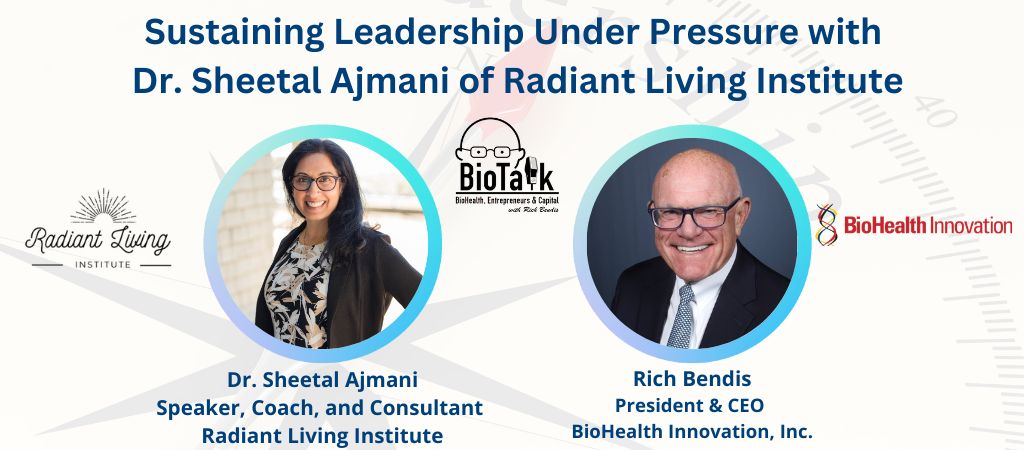
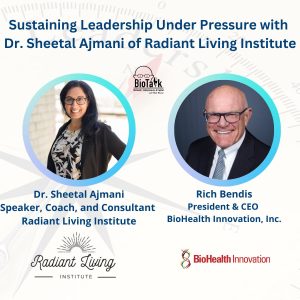 Dr. Sheetal Ajmani joins BioTalk to discuss a topic rarely addressed in the life sciences startup world. The personal and leadership toll that accompanies building and scaling a company. A physician turned executive coach and founder of Radiant Living Institute, Dr. Ajmani works closely with founders and senior leaders navigating intense professional pressure while trying to maintain clarity in decision making.
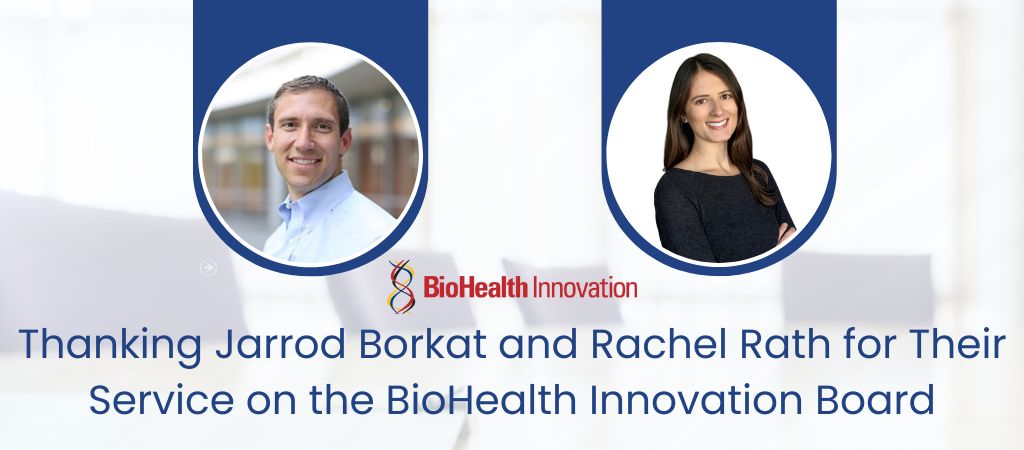
 BioHealth Innovation extends its sincere thanks to Jarrod Borkat, Chief Commercial and Strategy Officer at On Demand Pharmaceuticals, and Rachel Rath, Head of JLABS @ Washington DC, for their dedicated service on the Board of Directors.
 Last year, I wrote a
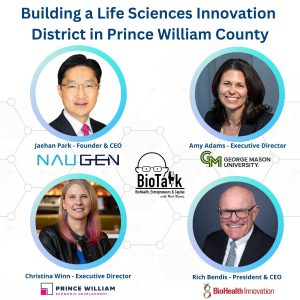 This episode of the BioTalk with Rich Bendis Podcast brings together leaders from industry, academia, and economic development to unpack the vision behind a new life sciences Innovation District anchored in Prince William County. With introductions to NAUGEN, George Mason University’s Institute for Biohealth Innovation, and the Prince William County Department of Economic Development, setting the stage for how each organization contributes to the district’s foundation. The guests discuss the life science assets, research strengths, and translational capabilities that define the district and explain why it is well-positioned to support biotechnology and advanced R&D companies.
 BioHealth Innovation is expanding its Entrepreneurs in Residence (EIR) network and is seeking experienced leaders at the intersection of biohealth and advanced technologies, including artificial intelligence and quantum computing.